


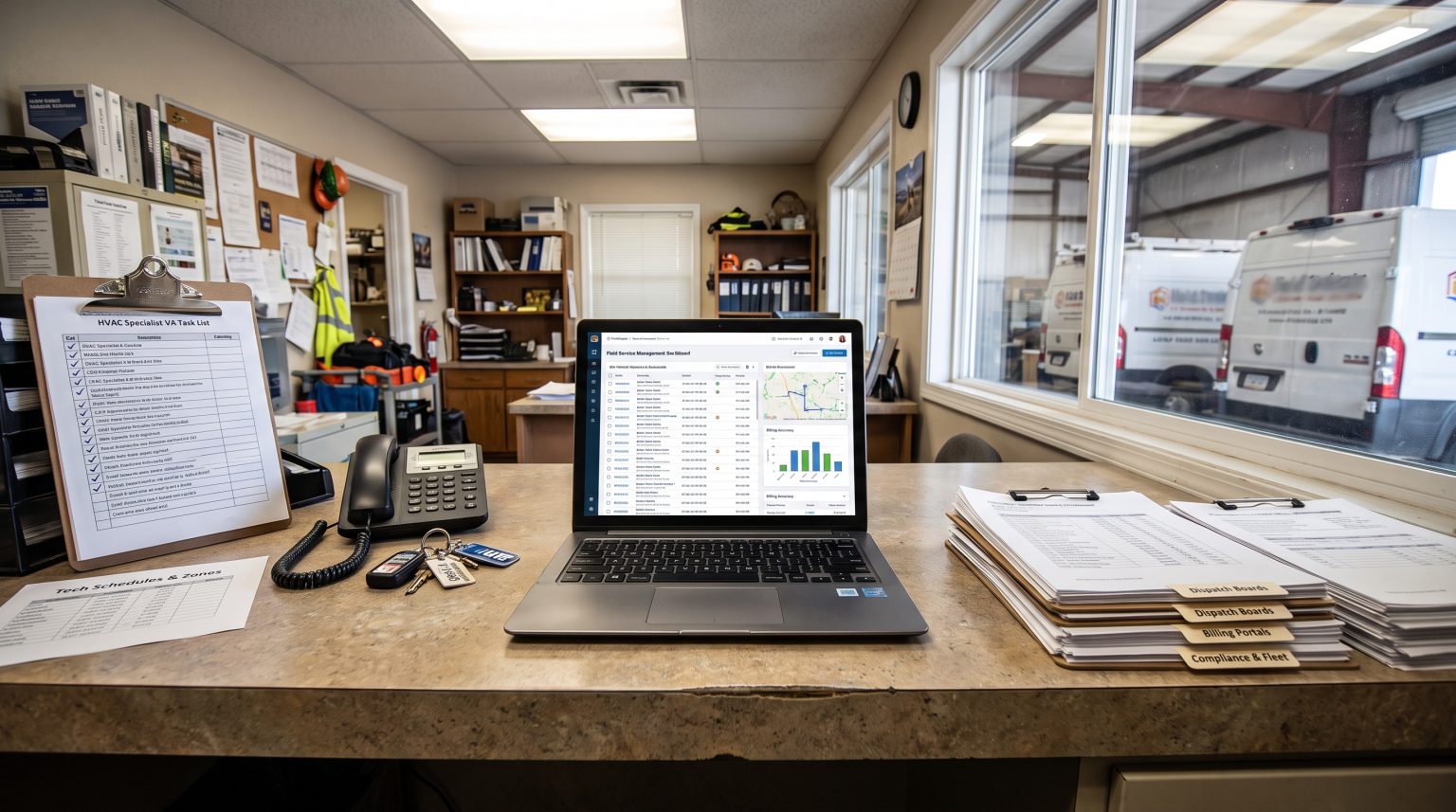
Running an HVAC company means managing a constant stream of moving parts. Technicians in the field, emergency calls coming in, invoices waiting to be submitted, seasonal surges stretching your team thin, and a back office that never really stops. Most HVAC business owners spend 15 to 30 hours every week on administrative work that pulls them away from the jobs that actually generate revenue.
The instinct is to hire help. And increasingly, that help comes in the form of a virtual assistant. But here is where many HVAC companies make a costly mistake: they hire a generalist VA expecting trade-level results, and they get neither the efficiency nor the relief they were looking for.
This guide breaks down why a virtual assistant for HVAC companies needs to be industry-specific, what that looks like in practice, and how to assess whether your business is ready to make the shift.
The Admin Overload That HVAC Companies Know Too Well
HVAC operations are operationally dense. Unlike many service businesses, HVAC contractors deal with dispatch coordination, compliance documentation, NTE approvals, portal-based billing, fleet management, payroll, collections, and emergency response, often all at once. During peak seasons, these pressures multiply.
The result is that owners and office managers end up buried in tasks that require attention but not necessarily their expertise. Billing loops stall cash flow. Dispatch errors frustrate technicians and clients alike. Platform migrations expose gaps in workflow. And every hour spent on admin is an hour not spent on customer relationships or business development.
This is not a staffing problem that any warm body can solve. It is a specialization problem.
Why Generalist Virtual Assistants Fall Short in the Trades
Generalist VAs can handle many business tasks competently: inbox management, basic scheduling, data entry, and content drafting. But HVAC operations require a different level of fluency.
A generalist VA will not know the difference between a recall job and a revisit. They will not understand how NTE limits affect billing approvals, how to navigate Corrigo or ServiceChannel portals, or how to flag a dispatch conflict before it becomes a missed appointment. Without that knowledge, the business owner ends up managing the VA rather than delegating to them, which defeats the purpose entirely.
The oversight burden alone erases much of the time savings a VA is supposed to provide. For established HVAC companies managing multiple technicians and clients, generalist support introduces risk rather than reducing it.
What Makes a Virtual Assistant for HVAC Companies Different
A specialist virtual assistant for HVAC companies brings three things a generalist cannot: field service knowledge, platform fluency, and trade-specific judgment.
Platform fluency means working confidently inside tools like BuildOps, ServiceTitan, Jobber, Corrigo, ServiceChannel, Verisae, Samsara, ADP, and BambooHR. These are the systems that run HVAC operations, and a VA who already knows them does not need weeks of onboarding before they can contribute.
Field service knowledge means understanding how dispatch boards work, how billing cycles connect to portal submissions, and how to prioritize an emergency call without being told how. Trade-specific judgment means knowing when to escalate, when to act, and how to handle client communications in a way that reflects well on the business.
At Doneverse, Doers are pre-trained and matched specifically to the business they support, so the learning curve is compressed and the value starts faster.
Core Tasks a Specialist HVAC Virtual Assistant Can Handle
The scope of what a well-trained virtual assistant for HVAC companies can manage remotely is broader than most owners expect. Here is a representative list of high-impact tasks:
- Service call intake from email, Slack, and customer portals
- Technician assignment and real-time dispatch board updates
- Emergency response coordination and escalation
- Recall and revisit job management
- Job-to-invoice conversion in field service platforms
- Portal invoice submission and rejection management
- NTE approval tracking and documentation
- Customer statement generation and delivery
- Aging invoice review and collections follow-up
- ACH payment processing
- Timecard verification in ADP or BambooHR
- PTO and absence tracking
- Onboarding documentation for new technicians
- Driver license and insurance compliance tracking
- Purchase order handling and approval routing
- Refrigerant and accounts payable invoice tracking
- Fleet asset record updates in Samsara
- ACA reporting support
- Customer follow-up calls and satisfaction checks
- Maintenance reminder and warranty alert communications
- Review request outreach after service completion
- CRM updates and lead tracking
- Compliance documentation filing
- Report generation for management review
- Scheduling coordination across multiple technicians and zones
This is the kind of operational coverage that transforms how an HVAC business functions day to day.
Generalist VA vs. HVAC-Specialist VA: A Direct Comparison
| Factor | Generalist VA | HVAC-Specialist VA |
|---|---|---|
| Platform Knowledge | Limited; requires training | Pre-trained on FSM tools |
| Onboarding Speed | 4 to 8 weeks minimum | Days to first live task |
| Task Accuracy | Moderate; errors common in trade-specific workflows | High; trained on HVAC processes |
| Oversight Required | High; owner must manage closely | Low; operates with independence |
| Error Rate in Billing | Higher; unfamiliar with portal logic | Lower; understands submission requirements |
| Scalability | Limited during seasonal surges | Flexible; adjusts to demand cycles |
| Customer Experience Impact | Inconsistent; lacks trade context | Consistent; understands urgency and tone |
| Annual Cost Comparison | Lower upfront; higher in oversight costs | Higher upfront; lower total cost of ownership |
Common Questions HVAC Owners Ask About Virtual Assistants
How can a virtual assistant reduce my admin time and costs?
A specialist VA takes over the recurring, time-consuming tasks that currently sit on your desk or your office manager’s plate. HVAC companies working with trained virtual assistants typically recover 15 to 30 hours per week in admin time. On the cost side, in-house trade administrators run between $63,000 and $85,000 per year when you factor in salary, benefits, and overhead. A specialist VA can deliver comparable output for a fraction of that, with documented savings ranging from $24,000 to over $100,000 annually depending on company size and scope.
What specific tasks can I delegate in my HVAC company?
Almost everything that does not require a licensed technician or a physical presence can be delegated. Dispatch coordination, billing, collections, payroll support, compliance documentation, customer communications, and portal management are all strong starting points. The list above covers the most common high-impact areas.
How do I know if I need a specialist VA instead of a generalist?
If your business manages more than a handful of technicians, uses field service management software, submits invoices through customer portals, or deals with seasonal demand swings, a generalist VA will likely create more work than they remove. The moment trade-specific knowledge becomes necessary for a task to be done correctly, specialization becomes non-negotiable.
What platforms and tools do HVAC VAs use?
The most common platforms include BuildOps, ServiceTitan, Jobber, Corrigo, ServiceChannel, Verisae, Samsara, ADP, BambooHR, Slack, and Google Workspace. A trained virtual assistant for HVAC companies should be able to operate within your existing tech stack without requiring you to rebuild your workflows around them.
Real Results From HVAC Companies Using Specialist Virtual Support
The outcomes are measurable. HVAC companies that deploy specialist virtual assistants consistently report recovering 15 to 30 hours per week in administrative time, improving first-pass billing accuracy, reducing invoice rejection rates, and accelerating cash flow through faster portal submissions and proactive collections follow-up.
Customer retention also improves. When follow-up calls, maintenance reminders, and post-service communications are handled consistently, clients feel attended to. Research consistently shows that the majority of customers who leave a service provider do so because of poor communication, not poor service quality. A dedicated virtual assistant closes that gap.
You can explore how businesses across service industries have achieved measurable results through dedicated virtual support on the Doneverse case studies page.
How to Assess Whether Your HVAC Business Is Ready
A few honest questions will tell you where you stand. Are you or your team spending more than 10 hours per week on tasks that do not require your direct expertise? Are billing errors or delays affecting your cash flow? Are customer follow-ups falling through the cracks during busy periods? Are you struggling to scale without adding full-time staff?
If the answer to any of these is yes, the operational case for a virtual assistant for HVAC companies is already there. The next step is finding the right fit.
When evaluating a VA provider, ask about industry-specific training, platform familiarity, onboarding timelines, and how they handle quality assurance during the first 90 days. Avoid providers who cannot demonstrate HVAC or field service experience. The cost of a poor match is not just the retainer fee; it is the errors, the missed follow-ups, and the time spent correcting mistakes.
Getting Matched With the Right Support for Your HVAC Business
Doneverse matches HVAC companies and other local service businesses with pre-trained Doers who are ready to work exclusively within your business from day one. There is no lengthy onboarding curve, no generalist guesswork, and no need to manage the VA as if they were a junior employee.
If your HVAC business is ready to recover time, reduce costs, and build a more scalable operation, explore how Doneverse supports local service businesses and take the first step toward getting matched with a Doer who understands your industry.
The right support does not just reduce your workload. It changes how your business operates.